
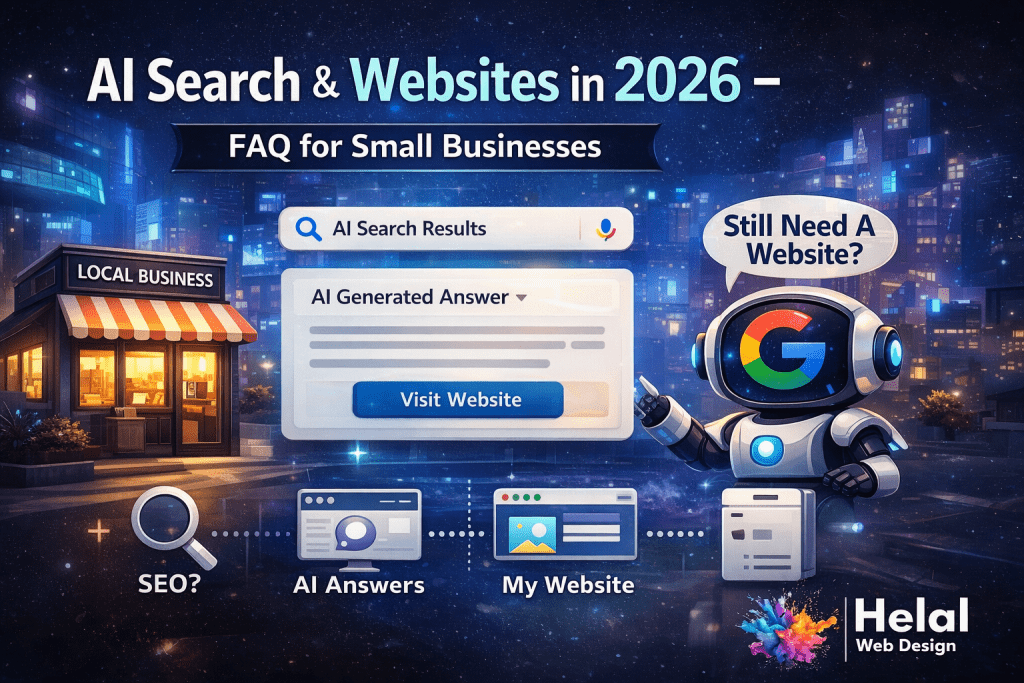
If you’re a small business owner, you’ve probably heard it by now:
“SEO is dead.”
“AI is taking over Google.”
“Websites won’t matter anymore.”
And honestly — it’s enough to make anyone feel confused or even a bit worried.
The truth is, a lot has changed. AI search is now part of how people find answers online, and yes, Google looks very different in 2026 compared to a few years ago. But that doesn’t mean small businesses are suddenly invisible — far from it.
This blog breaks things down in plain English. No hype. No tech waffle.
I’ll walk you through what’s really happening with SEO, AI search, and websites in 2026, answer the questions I get asked most, and explain what actually matters if you want your business to be found online today.
If you’ve been wondering whether your website is still worth it — or what you should even be focusing on anymore — this one’s for you.
Is SEO dead in 2026 because of AI?
Short answer: No. It’s just changed.
Long answer: SEO in 2026 is less about gaming the system and more about being clear, useful, and trustworthy.
Search engines like Google now use AI to summarise answers at the top of search results — but those answers still come from real websites written by real businesses.
If your website:
- Clearly explains what you do
- Uses natural language
- Answers common customer questions
You actually have a better chance of being picked up by AI search results.
SEO isn’t dead — lazy SEO is.
If Google gives AI answers, do I still need a website in 2026?
Yes. More than ever.
AI can answer questions, but it doesn’t replace trust.
When someone finds your business through Google or an AI search result, the next thing they usually do is check your website. They want to see who you are, what you offer, and whether you look like a real, reliable business.
In 2026, your website is still:
- Your digital shopfront
- Your proof of credibility
- The place where people decide if they contact you or move on
AI might introduce your business, but your website is what confirms the decision. Without one, you’re relying on hope instead of trust — and that’s where most enquiries are lost.
Can AI recommend my business if I don’t have a website?
Realistically? No.
AI tools don’t recommend businesses based on guesswork. They pull information from clear, structured sources — mainly websites that explain what a business does, where it’s based, and how customers can get in touch. This usually includes service pages, FAQs, and properly written content.
If your business doesn’t have a website, AI has nothing solid to reference or trust. Social media alone isn’t enough in 2026 — profiles change, information gets buried, and details aren’t always clear or consistent.
Even a simple one-page website that clearly shows your services, location, and contact details puts you miles ahead of businesses relying only on social media. It gives AI something reliable to understand — and gives potential customers confidence you’re a real, established business.
What type of website actually works best in 2026?
Simple ones.
I see this all the time — small businesses thinking they need something massive, expensive, and complicated.
In reality, the best-performing websites in 2026 are:
- One-page websites
- Fast loading
- Mobile-friendly
- Straight to the point
A clean one-page website can:
- Rank locally
- Work well with AI search
- Convert visitors into leads
Simple doesn’t mean cheap — it means effective.
How do I optimise my website for AI search in 2026?
This is the part where most people overthink it — and that’s usually where things go wrong. You don’t need secret hacks or fancy tools. AI search in 2026 is surprisingly simple. It favours websites that feel like they were written by a real person, for real people.
AI prefers websites that:
- Answer real questions customers actually ask
- Use natural, human language (not robotic SEO talk)
- Are easy to scan on mobile and desktop
If your site does that, you’re already ahead of most businesses.
Answer real questions (not just keywords)
Think about the questions people ask you before they become a customer.
Things like:
- How much does it cost?
- Do I really need a website?
- What’s included?
- How long does it take?
When your website answers these clearly, AI understands:
👉 What you do
👉 Who you help
👉 Why you’re relevant
This is why FAQ sections work so well in 2026 — they match how people search and how AI pulls answers.
Do blogs still matter in 2026?
Yes — but only if they’re useful.
Blogs aren’t about writing for the sake of it anymore, and they’re definitely not about pumping out content just to “look active”. In 2026, a good blog has a clear purpose: helping real people find clear answers.
Well-written blogs help AI and search engines understand what you actually specialise in. They show expertise, build trust, and make it easier for your business to appear in relevant searches — especially when people are asking specific questions.
Blogs also work quietly in the background. They answer common questions before a customer even contacts you, which means better-quality enquiries and less time explaining the basics.
FAQ-style blogs (like this one) are especially powerful in 2026 because they match how people now search — typing or speaking full questions into Google and AI tools. This type of content works well with AI summaries, supports long-term SEO, and keeps your website relevant even as search continues to evolve.
The key is simple: fewer blogs, better answers.
Is social media enough without a website?
Honestly? No.
Social media is great for visibility, updates, and staying in front of people — but it comes with limits. Algorithms change, reach drops overnight, and accounts can be restricted or even disappear without warning. When that happens, your business visibility goes with it.
Your website, on the other hand, is something you actually own. You control the message, the design, the content, and how people contact you. It doesn’t depend on an algorithm deciding who sees it that day.
In 2026, the strongest setup is a mix of all three:
Website + Social Media + SEO-friendly content
Social media brings attention and starts the conversation. Your website finishes it by building trust, answering questions, and turning visitors into enquiries. One supports the other — but without a website, social media is doing half the job.
What’s the biggest website mistake small businesses make in 2026?
Overcomplicating everything.
Most small businesses don’t need fancy animations, huge budgets, or endless pages. That stuff often slows sites down and confuses visitors instead of helping. What they actually need is simple: a clear message, a working contact form, and a website that loads fast and looks professional. If those basics are right, the site will do its job.
That’s it.
Final Thoughts
AI isn’t replacing websites.
It’s rewarding good ones.
If your website is clear, honest, and easy to understand, you’re already ahead of most businesses in 2026. That’s what AI search, Google, and real people are all looking for — not flashy design or clever tricks.
The businesses that are winning right now aren’t doing anything complicated. They’re explaining what they do clearly, making it easy to get in touch, and building trust through simple, well-structured websites.
In a world full of noise, clarity stands out. And that’s exactly what a good website gives you.
I build simple, affordable websites for small businesses that work with modern SEO and AI search — no pressure, no tech overwhelm.
🔗 https://helalwebdesign.com
📍 Basildon & Essex